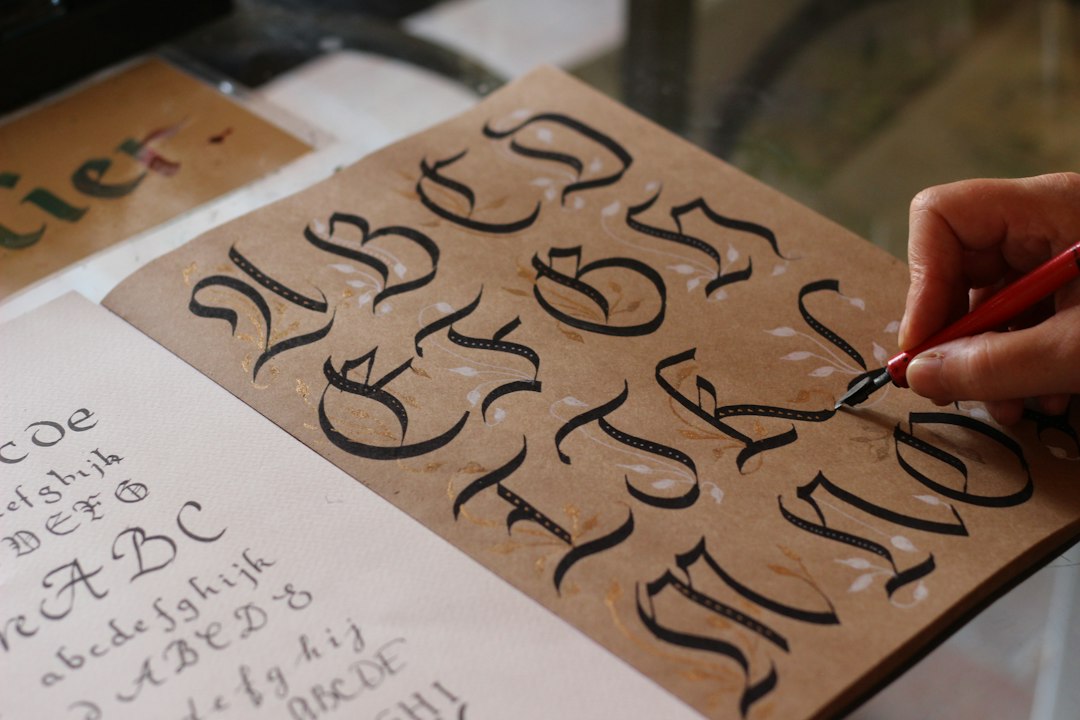
Illustrative artwork photographed by Samir Bouaked / Unsplash, not a product photo.
Quick verdict: Start with a small, firm brush tip such as the Tombow Fudenosuke Hard if you want controlled letters in a journal. Choose the softer Fudenosuke if your main goal is larger expressive strokes. The Pentel Sign Pen Brush Tip is another reasonably accessible route into pressure-sensitive lettering. An expensive 100-colour set will not fix shaky strokes; a single black pen and smooth practice paper are enough to learn the basics.
This comparison uses official product information, not claimed hands-on testing. The main question is how much tip flexibility you need and what letter size your page supports.
Quick Comparison
| Pen | Most useful for | Main trade-off |
|---|---|---|
| Tombow Fudenosuke Hard | Small text, beginner control | Less dramatic stroke variation |
| Tombow Fudenosuke Soft | Larger expressive letters | More pressure control required |
| Pentel Sign Pen Brush Tip | Everyday flexible lettering and sketch lines | Varies by ink and colour format |
| Tombow Dual Brush Pen | Large colourful designs and blending | Larger flexible tip harder in tight spaces |
| Ordinary fine liner | Learning letter shapes without pressure control | Cannot create true brush variation |
1. Tombow Fudenosuke Hard — Best for First Lessons
Tombow’s product page describes the Hard Tip as a firm yet flexible point able to make extra-fine, fine and medium strokes by varying pressure. Its black ink is water-based and pigmented, and the pen is non-refillable. This is a sensible starting tool for greeting cards, planner headings and lettering exercises where large loops would crowd the page.
Buy if: your writing is small or you struggle with controlling thick-to-thin transitions. Skip if: your goal is very large poster lettering; a bigger and softer tip may be easier for that scale. Protect the point with smooth paper and use a light touch on upstrokes.
Check U.S. options on Amazon | Check Canadian options on Amazon
2. Tombow Fudenosuke Soft — Best for Bigger Letters
According to Tombow’s lettering guide, the soft tip is especially suitable for large lettering while the hard version suits smaller fonts. More flexibility allows wider contrast between thick downstrokes and delicate upstrokes, but also makes it easier to over-press or lose a straight line while learning.
Buy if: you want expressive quotes and gift tags with more contrast. Skip if: you only write inside tiny bullet-journal boxes. A hard tip is often easier to master first.
Check U.S. options on Amazon | Check Canadian options on Amazon
3. Pentel Sign Pen Brush Tip — Best Alternative to Compare
Pentel Canada lists its SES15C Sign Pen Brush in a wide range of colours. The company describes a flexible tip and blendable water-based colours. Check the exact colour and regional listing before ordering because product descriptions can differ between black and colour variants. It is better to buy one or two colours and learn how the tip responds than pay for a large set before you know the writing feel suits you.
Buy if: you want a familiar felt-pen style with brush variation and affordable colour choices. Skip if: you require an archival guarantee for a specific colour or paper without checking that model’s ink specifications.
Check U.S. options on Amazon | Check Canadian options on Amazon
4. Tombow Dual Brush Pen — Best for Colourful Big Designs
The Tombow Dual Brush has both a flexible brush and a fine tip, with water-based blendable colour. It’s useful when you want broad lettering, outlines and fills in one instrument. The drawback for a new learner is that a large brush point magnifies pressure mistakes, and a big palette is unnecessary for black-ink stroke drills.
Buy if: your next step is colourful lettering or water-based blending. Skip if: you are still learning consistent thin upstrokes. Start with a smaller brush pen first.
Check U.S. options on Amazon | Check Canadian options on Amazon
5. A Fine Liner — Best for Practising Letter Shapes Cheaply
Not every beginner needs a brush marker on day one. A normal fineliner or pencil can teach letter spacing, x-height and proportions while you sketch guidelines. It won’t automatically produce the pressure-based thick-and-thin stroke, but you can draw the thicker parts manually to understand their placement before upgrading.
Buy: nothing new if a working pen is already on your desk. Skip: costly starter bundles until you know what kind of lettering you want to make.
Hard vs Soft Brush Tips: What Changes?
A firm tip resists bending, so it tends to give more predictable small lines. A softer tip responds to pressure more dramatically, allowing a thicker stroke but requiring better control when it springs back. Neither is universally superior: choose based on font size, the softness of your grip, and how consistently you can keep the upstroke narrow. Practice on a smooth sheet to avoid abrasive friction.
The Five-Minute Beginner Exercise
- Draw a row of light upward strokes; barely touch the page.
- Draw downward strokes with controlled pressure so each line is thicker.
- Connect upstrokes and downstrokes into U and N shapes.
- Write the same short word five times without increasing speed.
- Compare control with a hard and soft pen rather than judging only which produces darker ink.
Why Paper Can Matter More Than the Pen Price
Rough paper can wear a delicate brush point and make the stroke feel inconsistent. Both Tombow’s Fudenosuke specification and its wider brush-pen advice emphasize tip design and a gentle writing approach. Use smooth marker or laser paper for repeated drills, reserving textured art paper for appropriate methods.
Is a Full Colour Set Worth It?
Not for someone learning basic pressure control. A black Hard and a black Soft make a useful comparison at low overall cost. After your strokes are consistent, choose a handful of colours for the finished projects you actually make. The upgrade is worthwhile when it expands an established style, not when it simply fills a desk drawer.
Common Buying Mistakes
- Choosing an oversized tip for tiny bullet-journal headings.
- Pressing the nib hard on every stroke instead of differentiating up and down.
- Practising on coarse watercolor paper and fraying the tip.
- Buying dozens of colours before practising with black.
- Assuming every black and colour model uses identical ink chemistry.
- Confusing a brush pen with a rigid calligraphy chisel marker.
Frequently Asked Questions
Should beginners choose hard or soft?
For small and controlled lettering, hard is a practical default. Choose soft when you mainly make larger strokes and don’t mind a steeper learning curve.
Is Fudenosuke refillable?
The Fudenosuke Hard model linked above is listed as non-refillable. Check individual variants for specifications.
Can I letter with a normal marker?
Yes, but a rigid marker won’t vary line width through brush flex the same way. You can add thick parts manually for faux calligraphy.
Do brush pens work on printer paper?
Smooth premium laser paper can work well, but rough or absorbent copy stock may wear tips and feather ink. Test a single sheet.
Related Reading
Learn about smooth paper for brush pens and compare calligraphy paper for different lettering tools.
Affiliate disclosure: Scribblet may earn from qualifying purchases through U.S. and Canadian Amazon search links, at no extra cost to you. Product specifications come from manufacturers and we do not claim personal testing or guaranteed current prices.
Final Verdict
Best starting point: Tombow Fudenosuke Hard. Best for larger lettering: Fudenosuke Soft. Best alternative: Pentel Sign Pen Brush. Best for colour and blended projects: Tombow Dual Brush. Best value: buy one black pen first and practise.