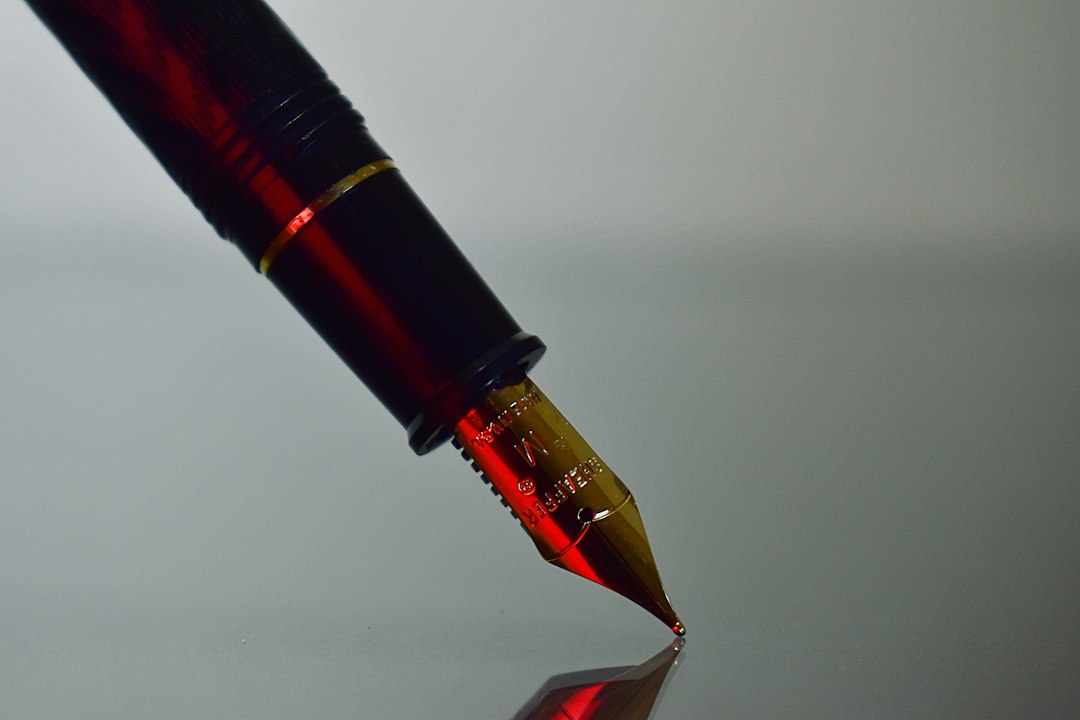
Illustrative photograph by Trey Gibson / Unsplash, not an ink product photograph.
Quick verdict: If you need fountain-pen notes that remain legible after an accidental splash, pigment-based ink designed specifically for fountain pens is worth considering. Sailor Seiboku and Souboku are documented pigment options; Platinum Carbon Black is a popular black alternative for sketching beneath washes. Ordinary dye ink is usually simpler to maintain and offers more colours, but it generally resists water less well. Water resistant does not mean absolutely waterproof, especially across every paper type.
This buying guide uses manufacturer and retailer specifications rather than pretending to have tested every ink. It focuses on the strength of the water-resistance claim, pen upkeep, and whether the upgrade is necessary for ordinary notes.
Quick Comparison
| Ink | Best for | What to watch |
|---|---|---|
| Sailor Seiboku | Blue-black water-resistant writing | Pigment care and cleaning |
| Sailor Souboku | Subtle blue-black daily writing | Not a promise of total waterproofness |
| Platinum Carbon Black | Dark line art beneath watercolour | Requires diligent pen maintenance |
| Standard dye-based fountain-pen ink | Low-fuss journaling and colour choice | Can lose legibility when wet |
What “Waterproof” Really Means for Fountain Pen Ink
Sailor’s own ink FAQ explains that dye inks dissolve in water and tend to be less resistant to washing and fading. Its pigment inks generally resist water and light better, yet even Sailor’s Kiwaguro, Seiboku and Souboku are not guaranteed completely water-insoluble. In its envelope example, text may remain readable after rain while some colour still transfers into the water. This careful distinction matters: buying a pigment ink is not insurance against a flooded notebook.
1. Sailor Seiboku — Best Blue-Black Pigment Choice
Official Sailor Seiboku product information describes a 50 ml blue-black pigment ink using small pigment particles, intended to reduce clogging and support comfortable writing. Sailor also emphasizes low bleed-through and broad use across illustrations and documents. Those are manufacturer claims rather than comparative laboratory proof against every other ink.
Buy if: you want water-resistant blue-black writing in a compatible fountain pen and accept regular cleaning. Skip if: your notes never leave a dry desk or you routinely let a pen sit unused for months.
Check U.S. options on Amazon | Check Canadian options on Amazon
2. Sailor Souboku — Best Understated Blue-Black
Sailor’s Souboku 50 ml specifications similarly identify a pigment-based ink made with small particles. The exact shade can vary with nib width and paper. Think of it as a subtly different colour and writing choice, not an automatic performance upgrade over Seiboku.
Buy if: you enjoy a muted everyday blue-black and want the manufacturer’s documented pigment system. Skip if: you already like the hue and handling of a less expensive waterproof ink, or you don’t need water resistance.
Check U.S. options on Amazon | Check Canadian options on Amazon
3. Platinum Carbon Black — Best for Ink-and-Wash Sketching
Specialist retailer Goulet Pen Company describes Platinum Carbon Black as a pigment-based 60 ml bottled ink valued for dark water-resistant linework under watercolor. It is also available in certain Platinum cartridges, but cartridge compatibility is brand- and model-specific. The retailer specifically cautions that pigment ink needs attentive fountain-pen maintenance.
Buy if: your drawings get a watercolour wash after lines dry. Skip if: your pen has unreliable sealing or will sit inked and unused for long stretches. Always test a dry line before applying a wash to finished artwork.
Check U.S. options on Amazon | Check Canadian options on Amazon
4. Standard Dye Ink — Best When Easy Maintenance Matters More
A conventional dye-based fountain pen ink is often easier to flush and comes in a large variety of colours. If your planner stays dry and you make temporary notes, paying for special pigment ink may bring little value. Dye formulations vary, however: some retain parts of their lines after spills, so assess the particular ink rather than assuming every dye completely vanishes.
Buy if: you value simple changes, variety and easy cleaning. Skip if: the information must remain legible after routine exposure to rain or spills.
Check U.S. options on Amazon | Check Canadian options on Amazon
How to Protect a Pen Using Pigment Ink
- Check that the ink is explicitly designed for fountain pens; India ink and calligraphy ink are not substitutes.
- Keep the cap fitted or nib retracted between writing sessions to avoid drying.
- Follow the pen and ink manufacturers’ cleaning instructions, especially if leaving it unused.
- Flush with suitable clean water when switching colours or before extended storage.
- Never force-feed hardened residue through a delicate nib or solvent-clean without approval.
- Test performance on your real notebook, then evaluate whether water resistance is strong enough for the intended use.
Does Pigment Ink Always Need a Special Fountain Pen?
No blanket compatibility rule covers every pen. Many modern designs can use fountain-pen-approved pigmented inks, but seal quality, filling mechanism, cleaning access and manufacturer instructions matter. Some pens have restricted ink compatibility. If your pen is valuable, vintage or difficult to clean, get model-specific confirmation before switching.
Is the Upgrade Worth the Money?
For a field notebook, sketchbook or recipe book regularly near water, an appropriate pigment ink may earn its place. For mostly digital notes or a dry study desk, standard dye ink is often enough. Factor in bottle volume, shipping, cartridges or converters, pen-maintenance time and the cost of replacing a clogged pen. An inexpensive sample can help you decide before buying a large bottle.
Common Buying Mistakes
- Treating “water-resistant” as a guarantee against complete submersion.
- Putting India ink or India-style drawing ink into a fountain pen.
- Leaving pigment ink to dry inside a rarely used instrument.
- Judging ink performance using only one very absorbent paper.
- Buying a large bottle before checking colour and pen compatibility.
- Assuming manufacturer water-resistance claims match archival certification.
Frequently Asked Questions
Is waterproof ink safe in every fountain pen?
No. Check exact ink and pen manufacturer guidance. A formulation explicitly intended for fountain pens is the starting requirement.
Is Seiboku completely waterproof?
Sailor cautions that its pigment inks are not a guarantee of zero colour transfer in all wet conditions.
Can I watercolour over Carbon Black?
It is commonly selected for that purpose, but let lines dry fully and test the exact combination before painting over finished art.
Do dye inks always wash away?
Not always. Resistance varies, but dye inks are generally more water-sensitive than pigment options as a category.
Related Reading
Compare general colours in our everyday fountain pen inks guide and learn safe flushing in our cleaning kit article.
Affiliate disclosure: Scribblet may earn from qualifying purchases using these U.S. and Canadian Amazon search links at no additional cost to you. Pricing and stock vary. This guide uses published manufacturer and retailer statements; it does not claim hands-on ink testing.
Final Verdict
Best blue-black for water resistance: Sailor Seiboku or Souboku depending on preferred shade. Best dark sketching ink: Platinum Carbon Black. Best value for a dry desk: keep a conventional dye ink that already works. Choose an ink based on the consequences of a spill—not a bigger list of ink bottles.