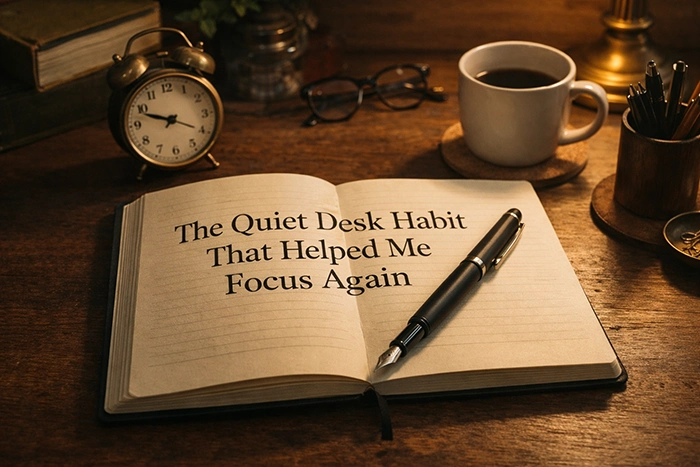
I didn’t change my schedule. I didn’t download a new app or overhaul my workflow. What helped me focus again was something much quieter than that — a small desk habit I started without really meaning to. It began on a morning when my thoughts felt cluttered before the day had even started. Instead of forcing myself to work through it, I paused and cleared just one small area of my desk. Not everything. Just enough space to breathe.
There’s something about a desk that reflects your mental state more than you realize. When papers pile up, pens scatter, and half-used notebooks stack on top of each other, your attention does the same thing. I noticed that even when I wanted to focus, my eyes kept darting from one object to another. So I tried something simple: before doing anything else, I reset my desk to the same calm baseline every morning.
The habit itself is almost invisible. I put the notebook I’m using front and center. I place one pen beside it — the same one every time. Everything else gets pushed slightly out of reach. Not hidden away, just quieted. The desk stops asking questions. It stops offering options. It becomes a single invitation instead of a dozen distractions.
What surprised me most was how quickly my body learned the rhythm. The moment I sit down and see that familiar setup, my shoulders drop a little. My breathing slows. I don’t have to decide what to work on — the space already knows. Focus doesn’t feel forced anymore. It feels welcomed.
This habit didn’t make me more productive overnight, but it made starting easier. And on days when motivation is thin, that’s everything. The desk doesn’t need to be perfect. It just needs to feel intentional. That small signal — that this space is for one thing — brought my attention back when it felt like it had drifted too far.
🖊️ I didn’t fix my focus by doing more — I fixed it by making my desk quieter.
📦 Buy on Amazon USA
📓 Leuchtturm1917 Medium A5 Notebook
🗂️ Simple Wooden Desk Organizer
🌿 Final Thoughts
Focus often returns the same way it left — slowly, and without fanfare. It doesn’t always respond to big changes or strict systems. Sometimes it just needs a calmer place to land. A quiet desk can become a form of permission, reminding you that it’s okay to do one thing at a time.
There’s a kind of respect in preparing a space before asking your mind to work. It signals care instead of urgency. And when your environment stops pulling at your attention, your thoughts are more willing to settle.
If you’ve been feeling scattered lately, try listening to what your desk is saying. A small, consistent habit might be all it takes to hear yourself think again.