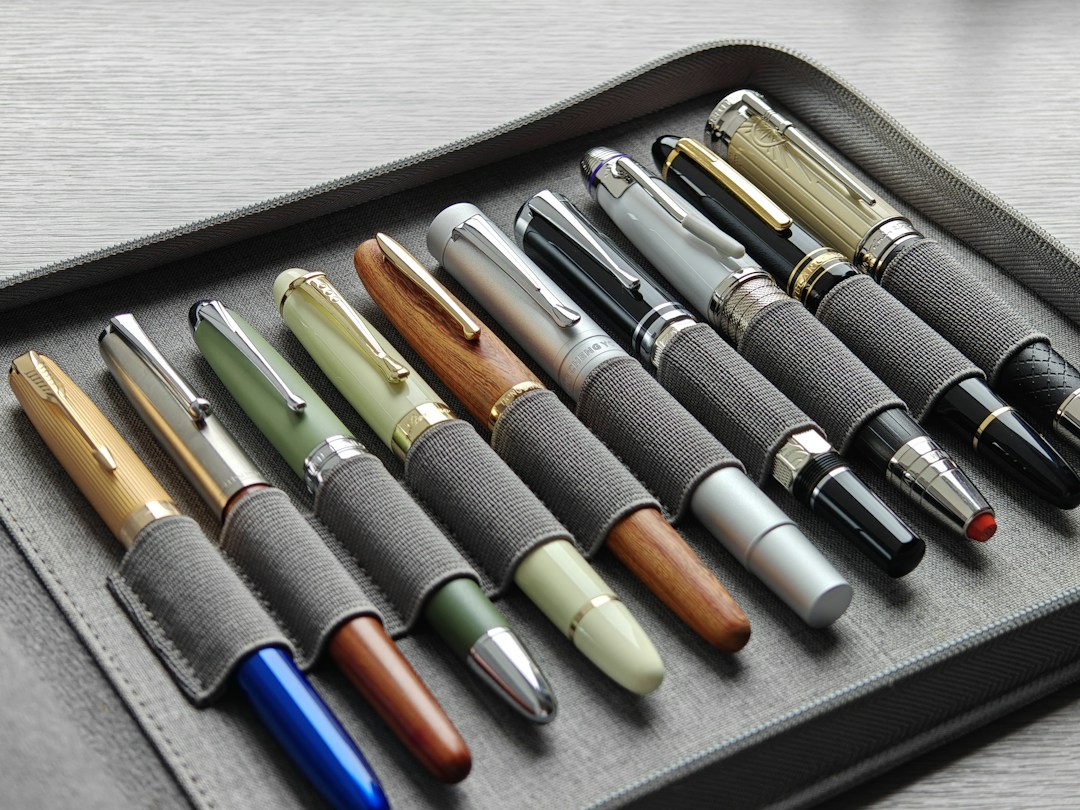
Quick verdict: If you carry one fountain pen, choose a properly sized, snug single-pen sleeve. If you rotate two or three valuable pens, a divided three-slot case offers better organization and protects finishes from rubbing together. Skip expensive leather if an inexpensive padded fabric case meets your needs.
A fountain pen case is a small purchase with one important job: protect your pens from scratches, pressure and impact while you travel or store them. The best design depends less on appearances than on how many pens you carry, their dimensions and the way you pack your bag.
Single Sleeve vs Three-Pen Case: Quick Comparison
| Feature | Single sleeve | Three-pen case |
|---|---|---|
| Ideal owner | One daily writer | Someone rotating two or three pens |
| Space | Fits a pocket or small notebook bag | More space and thickness |
| Protection | Protects the barrel when the fit is snug | Separates pens if each has its own slot |
| Downside | One pen only; open sleeves can let pens slide | Bulkier; closures or zippers need careful handling |
| Value | Best for one pen | Worth paying more for multiple pens |
Best Minimal Choice: A Single Fountain Pen Sleeve
A fitted sleeve prevents your favorite pen from rubbing against keys, a laptop charger or other stationery. Look for a soft interior, neat seams and a mouth that grips without forcing you to tug hard on a clip. A simple open-top sleeve is convenient, but it is not a sealed or crush-proof case.
For a concrete size reference, Galen Leather states that its single leather sleeve fits pens approximately 14 cm long and 1.6 cm in diameter, and lists commonly used fountain-pen models it has checked. Those dimensions are a guide to that sleeve only, not to every sleeve sold online. See the manufacturer’s size and fit details.
Buy it if: You mainly carry one capped pen and need a compact protector. Skip it if: Your pen exceeds the stated dimensions or you routinely pack several pens together.
Best for a Small Rotation: A Three-Slot Pen Case
Three compartments keep bodies and clips from knocking against one another. Prioritize dividers that run far enough down the case, gentle retention loops and a secure closure. A zippered case provides good containment, but check whether the pen clips can catch on the zipper. A flap case offers quick access, though the exact closure strength matters.
Galen Leather publishes a three-pen flap case with three individual slots and a stated fit of approximately 14 cm length and 1.5 cm barrel diameter. That’s narrower than the maker’s stated limit for its single sleeve, a useful reminder to measure before ordering. Read the maker’s case specifications.
Buy it if: You carry several pens with different nibs or inks. Skip it if: You only ever carry one pen, or need a protective hard-shell travel case.
Leather, Fabric or Hard Shell?
Leather: Attractive, often durable and pleasant to handle, but can show water marks and requires some care. Don’t assume leather automatically gives better drop protection than padded synthetics.
Fabric: Often lighter and less expensive. Look for padded walls and individual elastic loops; an unpadded zip pouch can still let pens collide.
Rigid shell: A sensible choice for crowded travel bags or expensive pens when compressive force is the main concern. Check its inner dimensions and lining carefully.
Five Things to Check Before You Buy
- Measure the capped pen: Check full length and widest barrel or cap diameter against the seller’s usable interior measurements.
- Check clip clearance: Clips and finials can snag at tight openings even when the barrel fits.
- Look for separation: When carrying multiple pens, choose individual sleeves or divided slots, not loose storage.
- Consider where you carry it: Pocket, tote, briefcase and checked luggage expose the case to very different pressures.
- Read returns and shipping details: Verify currency, availability and international delivery costs for Canada or the United States before ordering.
Is Premium Leather Worth It?
Paying more can make sense when you carry expensive pens daily and want carefully sewn slots, good fit and long service life. But there is no reason to spend heavily just to store an inexpensive everyday pen in a desk drawer. The cheaper case can be the better purchase when it offers enough separation and a secure closure.
Common Questions
Can a pen sleeve stop ink leaks?
No. A sleeve may contain minor staining, but it cannot prevent leaks from temperature changes, loose converters or damaged pen components. Keep pens capped and follow their manufacturer’s transport advice.
Is a three-pen case safer than a pouch?
Usually for scratch protection, provided each slot properly separates the pens. A pouch with padded dividers can also work. For drops and crushing, a rigid case may be a better choice.
Will oversized fountain pens fit?
Not always. Check both width and capped length; the shape of the cap, clip and finial can matter as much as nominal barrel diameter.
Related Reading
For pairing a case with a good daily writer, see our guide to fountain pen nib sizes and our fountain pen cleaning kit guide.
Final Verdict
Choose a single sleeve for one favorite pen and the lightest carry. Choose a three-slot divided case for a small rotation. If budget matters, a well-padded fabric option with separate compartments can make more sense than premium leather.
Disclosure: Scribblet may earn a commission from qualifying purchases through the Amazon USA and Amazon Canada links above at no extra cost to you. This is a researched comparison, not a hands-on product test. Amazon search results, prices and listings may change.