Tried Going Digital — This Is Why I Came Back to Paper
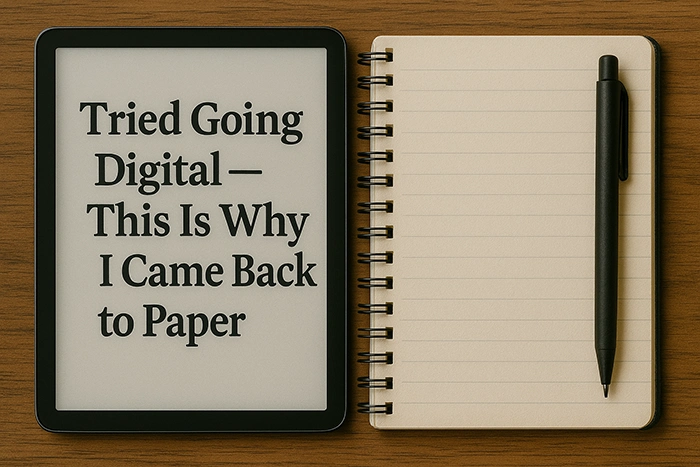
I really wanted digital to work for me. It made sense on paper—ironically. Everything synced, everything searchable, everything always with me. I downloaded the apps, tried different formats, even convinced myself that tapping notes into a screen was more efficient than writing them out. For a while, I stuck with it, mostly because I felt like I should.

But something was missing, and I couldn’t quite name it at first. Digital notes felt slippery. Thoughts went in, but they didn’t settle. I’d type something, close the app, and immediately feel like it hadn’t fully landed. The notes existed somewhere, but not with me. They were easy to create and just as easy to forget.

What I noticed most was how quickly digital writing pulled me away from the moment. A notification would slide in. A thought would turn into a task. A sentence would get edited before it even had time to be honest. Writing started to feel performative, like I was preparing information instead of releasing it. Even when I was alone, it felt like the screen was watching back.

Coming back to paper was quiet by comparison. No glow. No alerts. No temptation to clean things up mid-thought. Just friction—enough to slow me down. The pen moved at the speed my mind could handle, not faster. Mistakes stayed. Half-thoughts stayed. That made the writing feel more real, less filtered.

Paper doesn’t pretend to be efficient. It doesn’t organize for you. It doesn’t promise retrieval or backups. What it does offer is presence. When I write on paper, I’m fully there. I finish a line and actually feel like I’ve finished something. The thought doesn’t float—it lands.

I don’t think digital is wrong. It’s just not where my thinking wants to live. Paper gives my thoughts weight. It makes them feel considered, even when they’re messy. And in a day filled with screens, having one small space that stays offline has turned out to matter more than I expected.


📦 Buy on Amazon USA

📓 Lined Notebook for Everyday Writing
🖊️ Smooth Writing Pen (Black Ink)


🌱 Final Thoughts

Switching back to paper reminded me that tools shape how we think, not just how we store things. Writing by hand slows me down in a way that feels supportive instead of limiting.

There’s something grounding about knowing a thought exists only where you wrote it. No syncing, no searching—just ink and paper, right where you left it.

I didn’t come back to paper because it’s better. I came back because it feels more honest. And lately, that’s what I’ve been looking for.


📦 Buy on Amazon Canada

📓 Lined Notebook for Everyday Writing
🖊️ Smooth Writing Pen (Black Ink)
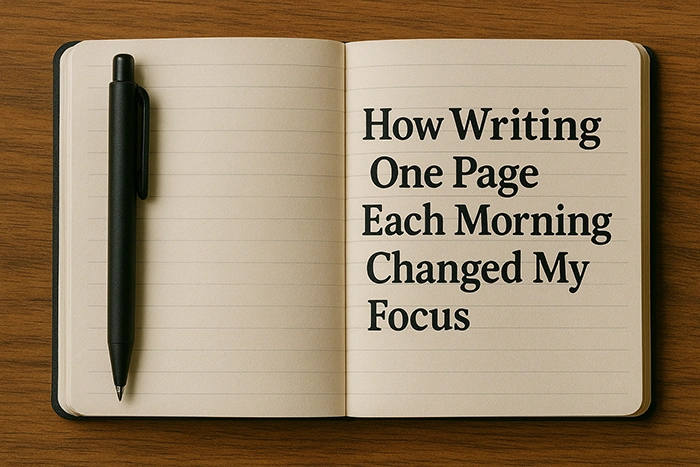
How Writing One Page Each Morning Changed My Focus

I didn’t start with a plan to improve my focus. I wasn’t trying to fix anything. I just noticed that my mornings felt scattered, like my attention was already split before the day really began. One morning, instead of reaching for a screen, I opened a notebook and wrote a single page. Not a journal entry. Not goals. Just whatever was already floating around in my head.

What I wrote didn’t matter much. Some days it was practical—things I needed to remember, small worries, half-made decisions. Other days it was repetitive, even dull. But finishing that one page did something subtle. It felt like closing open tabs in my mind. Nothing dramatic changed, but the noise softened. When I stood up from the desk, I felt more present than usual.

Over time, that one page became a boundary between before and after. Before the page, my thoughts were loose and reactive. After it, they felt quieter, more settled. I wasn’t suddenly more productive, but I was less distracted by unfinished thoughts. Writing them down gave them somewhere to go, so they stopped following me around all morning.

What surprised me most was how little effort it took. One page isn’t ambitious. It doesn’t invite perfection. Some mornings the writing was neat, other mornings it barely filled the space properly. That inconsistency turned out to be important. It removed pressure. I showed up because the task was small, and because it didn’t ask me to be “good” at it.

Now, the page isn’t about reflection or insight. It’s about clearing space. I don’t reread it often. I don’t organize it. I just write, stop, and move on. And somehow, that simple act has made the rest of the day feel more focused—not sharper, but calmer. Like I’m starting from a quieter place.


📦 Buy on Amazon USA

📓 Simple Lined Notebook
🖊️ Smooth Writing Pen (Black)


🌱 Final Thoughts

Writing one page each morning didn’t change how much I do, but it changed how it feels to do it. There’s a steadiness that comes from starting the day by putting thoughts somewhere tangible instead of carrying them all at once.

I’ve learned that focus doesn’t always come from trying harder. Sometimes it comes from unloading what’s already there. One page is enough to do that, at least for me.

It’s a small habit, but it’s one I return to because it gives me something rare in the morning: a sense of quiet direction before the day begins.


📦 Buy on Amazon Canada

📓 Simple Lined Notebook
🖊️ Smooth Writing Pen (Black)

The Pen That Never Interrupts My Thoughts

I didn’t realize how often a pen can interrupt a thought until I used one that didn’t. No skipping. No scratching. No sudden break in the line that pulls you out of what you were trying to say. Just a smooth, quiet movement across the page that lets your hand keep up with your mind. It’s a small thing, but once I noticed it, I couldn’t un-notice it.

This pen doesn’t ask for attention. It doesn’t feel special when I pick it up, and that’s exactly why it works. There’s no moment of adjustment, no testing it on the side of the page, no pause to see if the ink will cooperate. The words just continue. That continuity matters more than I ever gave it credit for. When the pen disappears, the thinking stays intact.

I’ve found myself writing longer without realizing it. Not because I’m trying harder, but because nothing is getting in the way. The pen doesn’t drag. It doesn’t fight the paper. It doesn’t remind me that I’m holding a tool at all. It feels closer to thinking out loud than writing something down. That’s rare.

What surprised me most is how calming that consistency feels. On days when my thoughts feel scattered, having a pen that behaves predictably is grounding. One less variable. One less tiny frustration. It’s not about speed or precision—it’s about trust. I know it will work, so my attention stays where it belongs.

I used to think pens were interchangeable. Now I see them more like background music. When it’s right, you don’t notice it at all. And when it’s wrong, it’s impossible to focus on anything else. This one stays out of the way, and that’s exactly what I need.


📦 Buy on Amazon USA

🖊️ Smooth Writing Gel Pen (Black)
🖊️ Fine Tip Everyday Writing Pen


🌱 Final Thoughts

There’s something reassuring about tools that don’t demand anything from you. This pen doesn’t try to improve my handwriting or make me more efficient. It simply lets me keep going. That alone has made it a permanent part of my desk.

Writing feels more natural when nothing interrupts the flow. No pauses. No corrections. Just a steady line from thought to page. It’s a reminder that sometimes the best tools are the ones you barely notice.

I don’t reach for this pen because it’s special. I reach for it because it’s invisible—and that’s exactly why it works.


📦 Buy on Amazon Canada

🖊️ Smooth Writing Gel Pen (Black)
🖊️ Fine Tip Everyday Writing Pen

Why I Write the Same Things Over and Over — And Why That’s Okay

I used to catch myself mid-sentence and stop. I’d think, haven’t I written this before? The same reminder. The same thought about slowing down. The same note about what matters and what doesn’t. For a while, that made me feel lazy, like I was failing some invisible creativity test. Eventually, I realized something quieter was happening instead.

The truth is, I don’t write things down because they’re new. I write them down because they’re easy to forget. The repetition isn’t a lack of ideas — it’s a reflection of being human. The same thoughts come back because the same pressures come back. The same worries. The same small reminders I need to hear again. Writing them once doesn’t make them permanent. Writing them often makes them stick.

There’s comfort in seeing familiar lines appear on a fresh page. It’s not about saying something clever. It’s about anchoring myself. Some days the words land differently. Other days they feel almost copied, but even then, the act of writing slows me down just enough to notice where I am. I’ve stopped trying to force novelty and started paying attention to usefulness instead.

Over time, I’ve noticed that repetition brings clarity, not boredom. The ideas that matter most are the ones that survive being written again and again. They change slightly. They soften. They become more honest. A notebook doesn’t judge that. It doesn’t ask for originality. It just holds space for what keeps returning.

I’ve come to think of repeated writing as maintenance, not failure. Like tidying the same drawer or making the same cup of coffee every morning. Some things don’t need improvement — they just need to be revisited. And that’s more than okay.


📦 Buy on Amazon USA

📓 Simple Lined Notebook
📓 Softcover Journal for Daily Writing
✏️ Smooth Black Ink Pens


🌱 Final Thoughts

Rewriting the same ideas has taught me that growth isn’t always visible. Sometimes it looks like circling the same thought until it finally feels settled. Other times it’s just a reminder that I’m still paying attention.

There’s relief in letting go of the need to constantly say something new. Familiar words can still be meaningful, especially when they meet you in a slightly different place each time.

If a thought keeps returning, maybe it’s asking to be written again — not because it’s unfinished, but because it matters.


📦 Buy on Amazon Canada

📓 Simple Lined Notebook
📓 Softcover Journal for Daily Writing
✏️ Smooth Black Ink Pens

The Notebook I Keep Beside Me All Day (Without Overthinking It)

I didn’t plan for this notebook to become something I carry around all day. It wasn’t a system, or a reset, or a fresh start. It just ended up beside me one morning, open on the desk, and never really moved. No pressure to fill pages. No rules about handwriting. No intention beyond having somewhere to put a thought when it showed up. That alone made it different from every other notebook I’ve tried to “use properly.”

What surprised me most was how often I reached for it without thinking. A line during coffee. A reminder before heading out. A half-formed idea that didn’t deserve an app or a folder. I didn’t decorate it. I didn’t label sections. I didn’t care if the writing slanted or stopped mid-sentence. It became a place where thoughts could land safely without asking to be organized first. That felt quietly freeing.

There’s something grounding about having one physical object nearby all day. Screens ask for attention. This notebook doesn’t. It just waits. Sometimes I don’t write in it for hours, and that’s fine. Other times it fills quickly, messy and uneven. I’ve learned that the value isn’t in what it looks like afterward, but in how it changes the moment I’m in. Writing something down seems to lower the volume in my head just enough to breathe.

I think that’s why this notebook stuck. Not because it made me more productive, but because it removed friction. No unlocking. No searching. No deciding where something belongs. It’s simply there, and that’s enough. Over time, it’s become less about capturing ideas and more about creating a calm space beside me—something solid and real in a day that otherwise feels very digital.


📦 Buy on Amazon USA

📓 Minimalist Lined Notebook
📓 Dotted Journal Notebook
✏️ Smooth Writing Gel Pens (Black)


🌱 Final Thoughts

There’s a quiet kind of relief that comes from not overthinking tools. This notebook doesn’t promise clarity or transformation. It just gives me a place to put things down, and sometimes that’s all I need. I didn’t realize how much mental space I was wasting holding onto small thoughts until I stopped holding them at all.

Keeping it beside me has changed the rhythm of my day in subtle ways. I pause more. I write shorter things. I let ideas be incomplete. That’s been unexpectedly helpful, especially on days when everything else feels rushed or fragmented.

In a world full of systems and optimization, this notebook reminds me that simple can still be effective. Not because it does more—but because it asks less.


📦 Buy on Amazon Canada

📓 Minimalist Lined Notebook
📓 Dotted Journal Notebook
✏️ Smooth Writing Gel Pens (Black)

Why My Best Ideas Never Start on a Screen

For a long time, a blank page felt like a test I was already failing. I’d open a notebook and immediately feel the pressure to get it right — the first sentence, the handwriting, the direction of the thoughts. The emptiness wasn’t peaceful; it was demanding. It asked me to be clear before I was ready, confident before I had warmed up. And more often than not, that pressure kept me from writing anything at all.

What changed wasn’t a breakthrough idea or a new system. It was noticing how patient the page actually is. The blankness doesn’t rush you. It doesn’t care if your first line is messy or forgettable. It just waits. Once I stopped treating the page like something that needed to be impressed, the tension eased. I started allowing myself to write badly on purpose — crooked letters, incomplete thoughts, sentences I knew I’d never come back to.

There’s a strange relief in realizing that perfection isn’t a requirement for beginning. The blank page doesn’t ask for polish; it asks for honesty. When I let go of the need to make the page look a certain way, I felt freer to explore what I was actually thinking. The writing became more human, less rehearsed. And oddly enough, that’s when it started to feel more meaningful.

I’ve learned that perfection often disguises itself as preparation. We tell ourselves we’re waiting for the right words, the right mood, the right clarity. But the blank page taught me that clarity usually comes after you start, not before. Letting go of perfection wasn’t about lowering standards — it was about trusting the process enough to begin imperfectly.

Now, when I open a new page, I don’t try to fill it beautifully. I try to fill it honestly. The page doesn’t need me to be finished or certain. It just needs me to show up. And that small shift has made writing feel lighter, kinder, and far more sustainable.

🖊️ The blank page didn’t ask me to be perfect — it asked me to be present.


📦 Buy on Amazon USA

📓 Leuchtturm1917 Medium A5 Notebook

📓 Moleskine Classic Softcover Notebook

🖊️ Pentel EnerGel Liquid Gel Pens


🌿 Final Thoughts

Perfection has a way of keeping us stuck at the starting line, convincing us that readiness comes before action. A blank page quietly challenges that belief. It offers space without expectation, reminding us that beginnings don’t need to be polished to be valid.

There’s freedom in allowing yourself to write something unfinished, something flawed, something real. When perfection loosens its grip, creativity has room to move. The page becomes a place of exploration instead of evaluation.

If you’ve been hesitating to begin, consider what the blank page might already know. Letting go doesn’t mean giving up — sometimes it’s simply choosing to start without asking for permission first.


📦 Buy on Amazon Canada

📓 Leuchtturm1917 Medium A5 Notebook

📓 Moleskine Classic Softcover Notebook

🖊️ Pentel EnerGel Liquid Gel Pens

The Simple Pleasure of a Pen That Glides Without Thinking

There’s a particular moment when writing stops feeling like effort and starts feeling like motion. It happens when the pen disappears in your hand — when you’re no longer aware of grip, pressure, or pace. The words arrive without being pushed. The page fills without resistance. That’s the simple pleasure I keep coming back to: a pen that glides without thinking.

I didn’t always notice how much friction mattered. I used whatever pen was nearby and assumed the struggle was part of the process. But once I experienced that smooth, uninterrupted glide, it was hard to ignore the difference. My hand relaxed. My shoulders dropped. Writing felt less like a task and more like a quiet continuation of thought. The pen stopped interrupting me.

When a pen glides properly, it creates a kind of trust. You don’t brace for skips or scratches. You don’t slow down to compensate. Your hand moves at the same pace as your thinking, and that alignment feels surprisingly satisfying. It’s not about speed — it’s about continuity. One word leading naturally into the next without friction breaking the rhythm.

I’ve noticed that on days when my mind feels cluttered, a smooth pen helps me ease into writing instead of forcing my way in. There’s comfort in knowing the tool won’t get in the way. It lets me stay present, focused on the feeling of writing rather than the mechanics of it. The page becomes calmer because the motion is calm.

What I love most is how subtle the pleasure is. No fanfare. No productivity claims. Just the quiet enjoyment of ink flowing exactly as it should. Writing doesn’t need to be impressive to be meaningful. Sometimes it just needs to feel good in your hand long enough for your thoughts to catch up.

🖊️ When a pen glides effortlessly, thinking feels less like effort and more like permission.


📦 Buy on Amazon USA

🖊️ Pentel EnerGel Liquid Gel Pens

✒️ Uni-ball Signo 207 Gel Pens

🖊️ Pilot G2 Gel Pens (0.7mm)


🌿 Final Thoughts

Small pleasures often have the biggest impact because they remove resistance instead of adding pressure. A pen that glides smoothly doesn’t make you a better writer — it simply makes writing easier to return to. And that ease matters more than we tend to admit.

There’s something grounding about tools that stay out of the way. When the pen stops demanding attention, your thoughts have room to move freely. Writing becomes less about control and more about flow, less about outcome and more about presence.

If writing has felt heavier than usual, consider how it feels in your hand. A pen that glides without thinking might be the quiet invitation you didn’t realize you were waiting for.


📦 Buy on Amazon Canada

🖊️ Pentel EnerGel Liquid Gel Pens

✒️ Uni-ball Signo 207 Gel Pens

🖊️ Pilot G2 Gel Pens (0.7mm)

Why I Keep One Notebook Just for Thoughts That Don’t Matter

For a long time, I treated every notebook like it needed a purpose. One for ideas. One for plans. One for things I didn’t want to forget. Somewhere along the way, writing started to feel like responsibility instead of release. That’s when I started keeping one notebook just for thoughts that don’t matter — and oddly enough, it became the one I reach for most often.

This notebook doesn’t need to make sense. It doesn’t need to be useful. It’s where half-formed thoughts go when they don’t belong anywhere else. Things I notice in passing. Questions I won’t answer. Complaints that don’t deserve airtime. Writing them down isn’t about preserving them — it’s about letting them pass through instead of linger.

There’s a strange freedom in knowing nothing in this notebook has to be good. I don’t reread it. I don’t organize it. Some pages are filled, others barely touched. Sometimes I’ll open it just to write a single sentence and close it again. The lack of importance is exactly what makes it work. It takes the pressure off my thinking and reminds me that not every thought needs to be examined or improved.

I’ve noticed that once I give myself permission to write things that don’t matter, the things that do matter show up more clearly elsewhere. It’s like mental clutter needs somewhere to land before deeper ideas can settle. This notebook acts as a kind of overflow space — a quiet place for the noise to go so it doesn’t crowd everything else.

What I appreciate most is how gentle the habit feels. There’s no expectation of insight or growth. Just movement. Just release. And on days when my mind feels busy but unfocused, that’s more than enough. Letting unimportant thoughts exist on paper keeps them from taking up too much space inside me.

🖊️ Some thoughts don’t need meaning — they just need somewhere to go.


📦 Buy on Amazon USA

📓 Minimalism Art Classic Notebook

📓 Moleskine Classic Softcover Notebook

🖊️ Pentel EnerGel Liquid Gel Pens


🌿 Final Thoughts

Not every thought deserves your attention, but ignoring them entirely can make them louder. Giving them a place to land — without judgment or purpose — creates a kind of balance. A notebook for thoughts that don’t matter isn’t wasteful; it’s practical in the quietest way.

There’s relief in separating what needs care from what just needs release. When everything is treated as important, nothing feels clear. This small boundary helps me think more gently and live with less mental friction.

If your mind feels crowded lately, consider keeping a notebook with no job at all. You might find that letting go of meaning is exactly what makes room for it later.


📦 Buy on Amazon Canada

📓 Minimalism Art Classic Notebook

📓 Moleskine Classic Softcover Notebook

🖊️ Pentel EnerGel Liquid Gel Pens

The Comfort of Writing Things Down When the Day Feels Heavy

Some days carry a weight that’s hard to name. Nothing is dramatically wrong, but everything feels slower, denser, harder to move through. On those days, I don’t try to fix the feeling or talk myself out of it. I sit down, open a notebook, and start writing things down — not to solve anything, but to make space for it all.

There’s a quiet relief in letting thoughts leave your head and land somewhere else. When the day feels heavy, everything seems to pile up internally — unfinished thoughts, small worries, things you didn’t say out loud. Writing doesn’t make them disappear, but it changes their shape. Once they’re on the page, they feel less tangled, less personal somehow. They become something you can look at instead of carry.

I don’t write neatly on those days. My handwriting slows and tilts. Sentences trail off. Sometimes it’s just fragments — a word here, a line there. The page doesn’t mind. It doesn’t interrupt or rush me. It holds whatever shows up without asking for clarity or resolution. And that kind of quiet acceptance is comforting in a way that’s hard to replicate elsewhere.

What I’ve come to appreciate most is how grounding the physical act feels. The steady movement of my hand. The soft sound of pen on paper. The simple rhythm of writing one line at a time. It pulls me out of my head and into the moment just enough to breathe again. The heaviness doesn’t lift completely, but it loosens its grip.

I used to think writing things down was about productivity or reflection. Now I see it differently. Sometimes it’s just an act of care — a way of saying, this matters enough to be noticed. And on days when everything feels like too much, that small acknowledgment can be enough.

🖊️ When I write things down on heavy days, I’m not trying to feel better — I’m just giving myself somewhere safe to set things down.


📦 Buy on Amazon USA

📓 Leuchtturm1917 Medium A5 Notebook

🖊️ Pilot G2 Gel Pen (0.7mm)

✒️ Uni-ball Signo 207 Gel Pens


🌿 Final Thoughts

Writing things down won’t magically lighten every heavy day, but it offers a kind of companionship that’s easy to overlook. It meets you where you are, without asking you to explain yourself or move faster than you’re ready to. In a world that constantly pushes for solutions, that gentleness matters.

There’s comfort in knowing you don’t have to hold everything at once. A notebook can carry some of that weight for you — quietly, reliably, without judgment. It doesn’t need to understand your thoughts to hold them.

If today feels heavier than usual, consider writing something down — anything at all. Not as a cure, but as a pause. Sometimes that pause is where the comfort begins.


📦 Buy on Amazon Canada

📓 Leuchtturm1917 Medium A5 Notebook

🖊️ Pilot G2 Gel Pen (0.7mm)

✒️ Uni-ball Signo 207 Gel Pens

How Slowing Down My Hand Changed the Way I Think

I didn’t set out to slow down my thinking. I was just tired of how rushed everything felt — my thoughts, my writing, even the way my hand moved across the page. Somewhere along the way, I started noticing that when I wrote quickly, my mind followed suit. Ideas jumped ahead of themselves. Sentences tripped over each other. Nothing had time to settle. So one afternoon, without much intention, I simply slowed my hand down.

At first, it felt almost uncomfortable. Writing more slowly made me aware of every stroke, every pause between words. I couldn’t rush to the end of a sentence because my hand wouldn’t let me. And in that space — between one word and the next — something unexpected happened. My thoughts began to line up instead of collide. I wasn’t thinking faster or smarter. I was thinking clearer.

There’s a quiet conversation that happens when your hand moves deliberately. The pen presses into the paper with intention. The letters take shape one at a time. You start listening to your thoughts instead of chasing them. I found myself choosing words more carefully, not because I had to, but because I finally had time to notice them before they escaped.

What surprised me most was how calming the process became. Slowing my hand slowed my breathing. It softened the urgency I didn’t realize I was carrying. Writing stopped being about getting ideas out before they disappeared and became more about staying present long enough to understand them. The page turned into a place to think, not just a place to record.

Now, when my mind feels cluttered or restless, I don’t try to fix it directly. I slow my hand instead. The thinking follows. It always does. And what starts as a physical choice — to move more deliberately — quietly reshapes the way my thoughts unfold.

🖊️ When I stopped rushing my writing, my thoughts finally felt like they were allowed to arrive.


📦 Buy on Amazon USA

🖊️ Pentel EnerGel Liquid Gel Pens

✒️ Uni-ball Signo 207 Gel Pens

📓 Leuchtturm1917 Medium A5 Notebook


🌿 Final Thoughts

We often assume that clearer thinking comes from effort or discipline, but sometimes it comes from patience. Slowing down your hand creates room for ideas to breathe before they’re pushed aside by the next one. It’s a gentle reminder that speed isn’t the same as progress.

Writing by hand can become a form of listening — to yourself, to what’s underneath the noise. When the movement is deliberate, the thinking naturally follows suit. There’s less pressure to be right and more space to be honest.

If your thoughts have been racing lately, try letting your hand lead the way instead. You might find that clarity isn’t something you need to chase — it’s something that shows up when you finally slow down enough to notice it.


📦 Buy on Amazon Canada

🖊️ Pentel EnerGel Liquid Gel Pens

✒️ Uni-ball Signo 207 Gel Pens

📓 Leuchtturm1917 Medium A5 Notebook