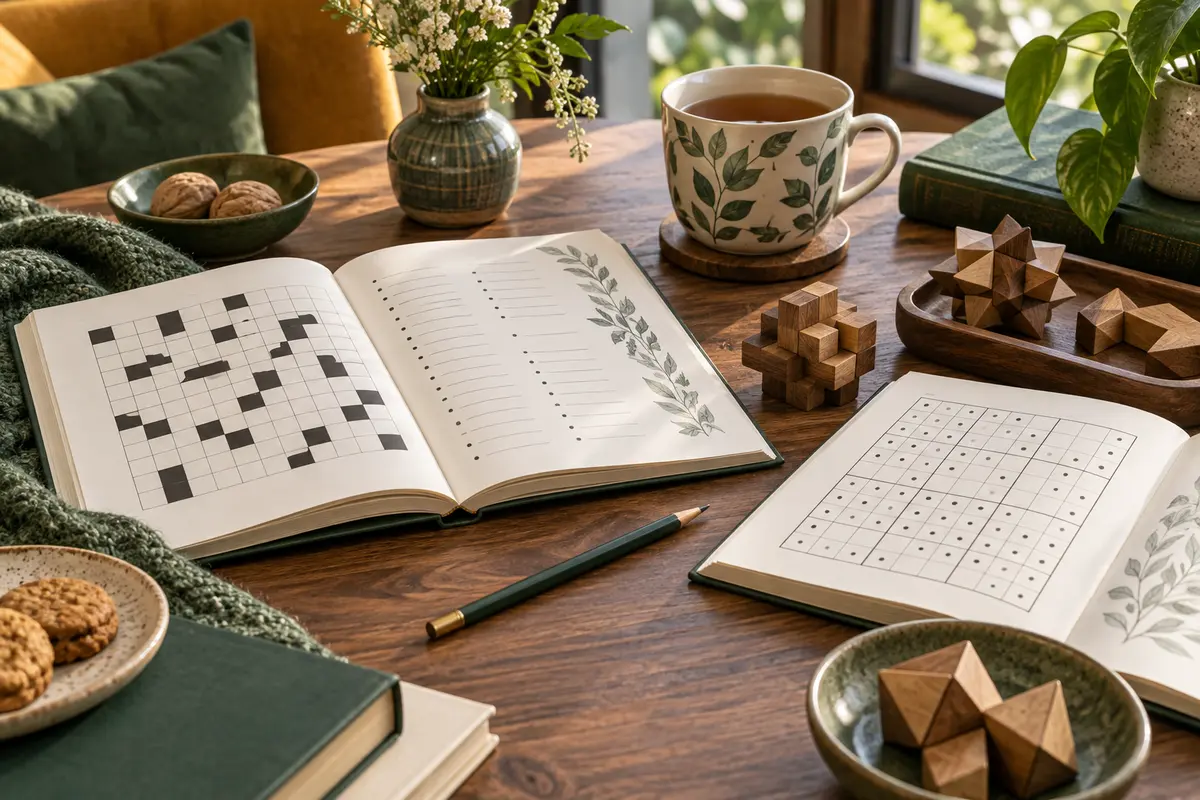
Quick verdict: The New York Times Mega Book of Sunday Crosswords is the strongest pick for committed word-puzzle fans. Choose Brain Games Sudoku for large, clear number grids, or Kanoodle when you want a reusable tactile challenge instead of a book.
A satisfying puzzle meets you at the right level: challenging enough to hold attention, but approachable enough that you want to return tomorrow. This guide mixes crosswords, sudoku, varied puzzle collections, and a hands-on spatial game so you can choose by format and session length—not by exaggerated promises.
The Best Brain Games and Puzzle Books at a Glance
| Pick | Best for | Why it stands out |
|---|---|---|
| The New York Times Mega Book of Sunday Crosswords | Best for crossword fans | A large collection of Sunday-sized crosswords offers substantial, sit-down challenges and plenty of material for experienced solvers. |
| Brain Games Sudoku Large Print | Best large-print sudoku | Large grids and clear presentation can make number puzzles easier to scan, especially during relaxed sessions at a table. |
| Mensa 10-Minute Crossword Puzzles | Best for short sessions | Compact crossword challenges are designed to fit into a coffee break, commute, or small daily routine without demanding a long sitting. |
| Kanoodle 3D Brain Teaser Puzzle | Best hands-on game | Colorful interlocking pieces turn the challenge into a tactile spatial puzzle, with both flat and three-dimensional arrangements to explore. |
| The Ultimate Brain Health Puzzle Book | Best variety | A mixed-puzzle collection helps readers rotate between word, number, logic, and visual challenges instead of committing to one format. |
A Note About “Brain Health” Claims
Puzzles can be enjoyable, absorbing, and mentally challenging. However, no book or game should be treated as a guaranteed way to prevent memory loss, dementia, or another medical condition. Buy these for recreation and a satisfying routine; discuss health concerns with a qualified professional.
Who This Guide Is For
These picks suit adults shopping for screen-free downtime, travel activities, gifts, or a small daily challenge. We included different formats because the puzzle you enjoy consistently is more useful than the “hardest” option left unopened on a shelf.
1. The New York Times Mega Book of Sunday Crosswords — Best for crossword fans
A large collection of Sunday-sized crosswords offers substantial, sit-down challenges and plenty of material for experienced solvers.
- Choose it if: You enjoy longer crosswords and want a deep collection.
- Skip it if: You are new to crosswords or prefer quick, low-pressure puzzles.
2. Brain Games Sudoku Large Print — Best large-print sudoku
Large grids and clear presentation can make number puzzles easier to scan, especially during relaxed sessions at a table.
- Choose it if: You want sudoku with a more readable page layout.
- Skip it if: You prefer wordplay, trivia, or mixed puzzle formats.
3. Mensa 10-Minute Crossword Puzzles — Best for short sessions
Compact crossword challenges are designed to fit into a coffee break, commute, or small daily routine without demanding a long sitting.
- Choose it if: You want brief word puzzles with a clear stopping point.
- Skip it if: You want oversized weekend-style grids.
4. Kanoodle 3D Brain Teaser Puzzle — Best hands-on game
Colorful interlocking pieces turn the challenge into a tactile spatial puzzle, with both flat and three-dimensional arrangements to explore.
- Choose it if: You want a reusable, screen-free puzzle rather than another book.
- Skip it if: You need an activity for several players at once.
5. The Ultimate Brain Health Puzzle Book — Best variety
A mixed-puzzle collection helps readers rotate between word, number, logic, and visual challenges instead of committing to one format.
- Choose it if: Variety keeps you interested and you like sampling different puzzle types.
- Skip it if: You want a specialist book with a consistent difficulty curve.
How to Choose the Right Puzzle
- Format: Word lovers may prefer crosswords; pattern thinkers may gravitate to sudoku or spatial pieces.
- Difficulty: Look for a gradual progression or a clearly labeled level that creates challenge without constant frustration.
- Session length: Ten-minute puzzles suit a daily habit, while large Sunday grids invite a longer weekend ritual.
- Readability: Larger type, uncluttered pages, and room for notes can matter more than page count.
- Reusability: A physical brain teaser can be reset and shared, whereas a book records progress and offers more total puzzles.
Make the Habit Enjoyable
Keep one puzzle where downtime already happens—beside a favorite chair, in a work bag, or near the coffee maker. Set a gentle time boundary and use pencil if perfection makes you hesitant. Looking up an unfamiliar word or checking an answer is part of learning the puzzle’s language, not a failure.
Keep Exploring Everyday Curiosity
After a puzzle session, explore the science of everyday luck or discover why we love tiny things—two more playful dives into how people notice and interpret the world.
Frequently Asked Questions
Which puzzle is easiest for a beginner?
Start with a format you already find appealing and an easy or mixed-difficulty collection. Short puzzles reduce the commitment and help you learn common conventions.
Are answer keys important?
Yes, especially for independent solving. A clear answer section lets you resolve sticking points and understand patterns instead of abandoning the book.
Do puzzles have to be difficult to be worthwhile?
No. Relaxation, enjoyment, and consistency are legitimate reasons to solve. The best difficulty is one that feels engaging and makes you want another round.
Disclosure: As an Amazon Associate, Scribble-It may earn from qualifying purchases. Editions, prices, and availability can change; confirm the current listing before buying.
Shop These Puzzles on Amazon Canada
The New York Times Mega Book of Sunday Crosswords — Check price on Amazon Canada
Brain Games Sudoku Large Print — Check price on Amazon Canada
Mensa 10-Minute Crossword Puzzles — Check price on Amazon Canada
Kanoodle 3D Brain Teaser Puzzle — Check price on Amazon Canada
The Ultimate Brain Health Puzzle Book — Check price on Amazon Canada
Final Verdict
The New York Times collection is the best fit for dedicated crossword solvers, while large-print sudoku offers a clean number-puzzle experience. Mensa works well in short bursts, Kanoodle adds tactile variety, and a mixed collection is the safest gift when you do not know the recipient’s favorite format.