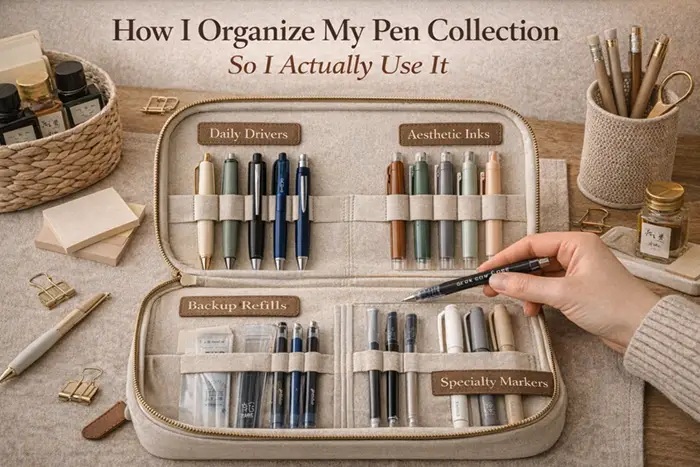
There was a point where I owned more pens than I could realistically justify — and somehow still reached for the same two every day. The rest lived in a cluttered pouch, half-forgotten, tangled together in a colorful but chaotic mess. It wasn’t that I didn’t like them. I just couldn’t see them clearly enough to use them.
Organization changed that.
Not in a hyper-productive, label-everything kind of way. Just a simple structure that made each pen easier to reach for. Once I stopped storing them randomly and started grouping them by purpose, my writing habits shifted almost immediately.
The first category I created was “daily drivers.” These are the pens that live at the front of my case. Smooth ink. Reliable flow. Neutral colors. The ones I grab without thinking. They deserve easy access because they carry most of the work. When they’re buried under specialty markers, I default to whatever’s closest instead of what feels best.
Behind them sit what I call “aesthetic inks.” These are the dusty browns, soft blues, muted greens — the colors I use when journaling slowly or marking something meaningful. They don’t need to be front and center, but they need visibility. When I can see them, I’m more likely to switch colors intentionally instead of writing everything in default black.
Then there are backup refills. This was the biggest upgrade. Instead of tossing refills into a drawer somewhere, I keep them in a small zip compartment inside the case. When a pen runs dry, I don’t abandon it — I refill it. That small shift keeps favorites in rotation longer and prevents clutter from building up.
Finally, specialty markers. Highlighters. Brush pens. Metallic inks. These don’t belong in the same space as daily tools. I moved them to a secondary pouch that sits beside my desk instead of inside my main pen case. That separation matters. It reduces visual noise. It keeps the primary case focused.
I didn’t realize how much I needed this until I slowed down long enough to use it.
The real benefit isn’t neatness. It’s accessibility. When everything has a loose category, I use more of what I already own. I rotate colors. I experiment. I refill instead of replace.
And maybe most importantly — I stop buying duplicates because I can finally see what I have.
Pen collections don’t need to be minimalist to be functional. They just need a little structure.
📦 Buy on Amazon USA
Large Capacity Canvas Pen Case with Compartments
MZebra Sarasa Clip Gel Pens (Assorted Colors)
uni Jetstream Ballpoint Pens (Black & Blue Set)
Zebra Mildliner Highlighters (Muted Set)
Universal Pen Refills (Multi-Pack)
🌿 Final Thoughts
Organizing your pens isn’t about aesthetics alone. It’s about reducing friction. When tools are easy to find, they’re easier to use.
A simple system — daily drivers, aesthetic inks, backups, specialty tools — keeps your collection intentional instead of overwhelming. It turns a pile into a toolkit.
And once your pens are organized, something unexpected happens: writing feels lighter. Not because you bought more — but because you’re finally using what you already have.
📦 Buy on Amazon Canada
Large Capacity Canvas Pen Case with Compartments
Zebra Sarasa Clip Gel Pens (Assorted Colors)
uni Jetstream Ballpoint Pens (Black & Blue Set)